By Talia Diller
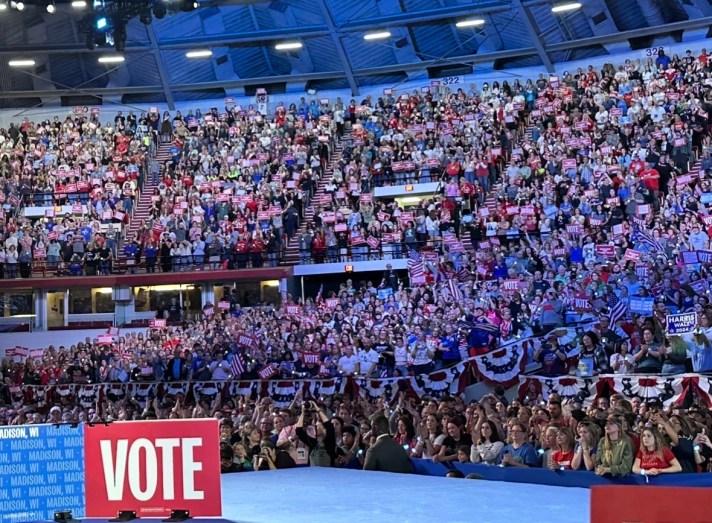
Abby Lamoreux knew who she was voting for before she walked through the door.
The University of Wisconsin-Madison sophomore had spent months following the presidential race online and arrived at the Madison Public Library to vote, confident she knew exactly where she stood.
Then she looked down.
There were names she did not recognize. Local initiatives she had never heard of. Races she could not place.
“There was a name, the female senator here,” Lamoreux said. “I recognized it because I would always see ads on TV with her name.”
That was the one she circled.
Recognition, not research, drove the choice.
Lamoreux is not alone.
At a university large enough to influence statewide elections, many students who closely follow national politics remain largely absent from the elections closest to them.
That absence is often read as apathy. But researchers and local officials say it reflects something else: a political information system that elevates national news more than local coverage and gives campaigns little incentive to reach young voters in the first place.
When candidates find ways to bring that information to students directly, the response can look very different.
★★★
Michael Wagner, director of the Center for Communication and Civic Renewal at the University of Wisconsin-Madison, studies how the information environment shapes political behavior. He said what Lamoreux experienced reflects how that environment now works.
In a 2025 study on multi-platform social media use published in Social Media + Society, Wagner and co-author Macau Mak found that what people encounter online depends less on how many platforms they use and more on who they follow, what they engage with and what their feeds resurface.
For students spending most of their time on Instagram and TikTok, fast-moving national politics rise quickly to the surface, while local stories move quietly.
“On social media, there’s just not a ton that helps people get exposed to local information unless they’re actively following a local news station, a local newspaper, or local political candidates,” Wagner said.
For Lamoreux, that structural gap is her daily experience.
“There’s less social media information about it, to be honest, and since that’s where I’m consuming most of my media, I don’t hear as much about it,” Lamoreux said.
Ask her what comes to mind when you say national politics, and she brings up Immigration and Customs Enforcement raids, tariffs and the Epstein files. Ask her about Wisconsin politics, and her answer is different.
“I feel like they fade to the background,” she said.
Not absent. Fading.
Low turnout in local elections is often treated as indifference, but that interpretation is incomplete.
“It’s more accurate to look at students as uninformed than as people who don’t care,” Wagner said.
When students hear less about local politics, they show up less. And instead of asking why that information isn’t reaching them, many candidates take it as a signal that young people are not worth pursuing.
“They basically see young people as a very small group of potential campaign volunteers, but not as a block of voters,” Wagner said. “So, they don’t speak to their issues.”
This does not mean young voters are unwilling to engage, but that they are easier for candidates to overlook. Campaigns focus where outreach is most likely to lead to voter engagement. As a result, older voters become the safer investment, and younger voters fall out of the calculation.
Breaking that cycle requires something more than symbolic outreach.
“People running for office would have to do more than give lip service to young voters. They would have to show up repeatedly. Showing up once and leaving is evidence that you don’t care,” Wagner said.
When that effort never comes, students are left to interpret the silence.
For Lamoreux, that silence was not a lack of attention or interest. It was a failure to be reached — not just by media sources, but by the candidates themselves.
★★★
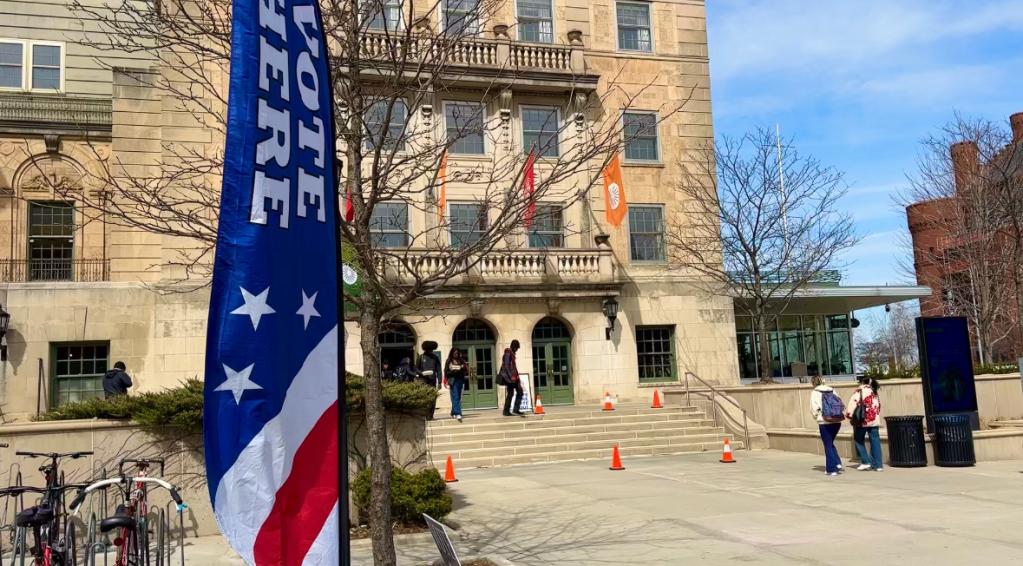
In Madison, District 8 Alder MGR Govindarajan, 24, saw that failure by politicians and decided to address it.
“I felt like they’re not really going to pay attention to students unless they have to,” he said.
Govindarajan, vice president of the Madison Common Council, represents a district that covers much of the UW-Madison campus.
In the weeks leading up to the April 2023 election, he knocked on about 4,000 doors across dorms and apartment buildings. On Election Day, he spent nearly 13 hours moving through campus, talking to students wherever he could find them.
Many students did not know what an alder was, that a city election was happening or how local government affected the things frustrating them most.
“Busy people like students don’t have the capacity and time to learn all the details themselves,” Govindarajan said. “It is up to the city to provide that information.”
So he talked to them about housing costs, bus schedules, street lighting and safety. As a student himself, he could connect city government to the problems shaping students’ daily lives.
He did not wait for local politics to reach them through the same channels that had already failed. He brought it to their doors and into their classrooms, going into lecture halls and discussion sections as a guest speaker and opening the floor to students’ questions.
“Long-form conversation is always the most efficient way of getting through to people,” Govindarajan said. “You can’t scroll past me when I’m standing in front of you.”
The result was hard to miss. In 2023, roughly 4,500 people voted in the District 8 alder race, more than any previous alder race in the district’s history. Even when he ran unopposed in his next election, about 4,000 students still showed up to vote.
But the engagement did not end at the ballot box. In his first year in office, Govindarajan sent students a survey about their housing experiences. Within 72 hours, 375 had emailed responses and another 1,700 filled out a form, the most the city had ever received from a single outreach.
The students described mold, bats, rats and landlords who ignored dangerous conditions. About half of the housing issues they reported were illegal. When Govindarajan brought those findings back to the city, inspections followed and renters saw real change.
★★★
Govindarajan is leaving the seat in 2026 to attend law school. What he leaves behind is simpler than a campaign strategy: students will show up when someone shows up for them, gives them the information they are missing and makes clear why it matters.
When asked what would make her vote in local elections, Lamoreux pointed to the same thing:
“Just the knowledge of it, and how much it would affect me, my peers and people around me.”
 thelocalgap.com